
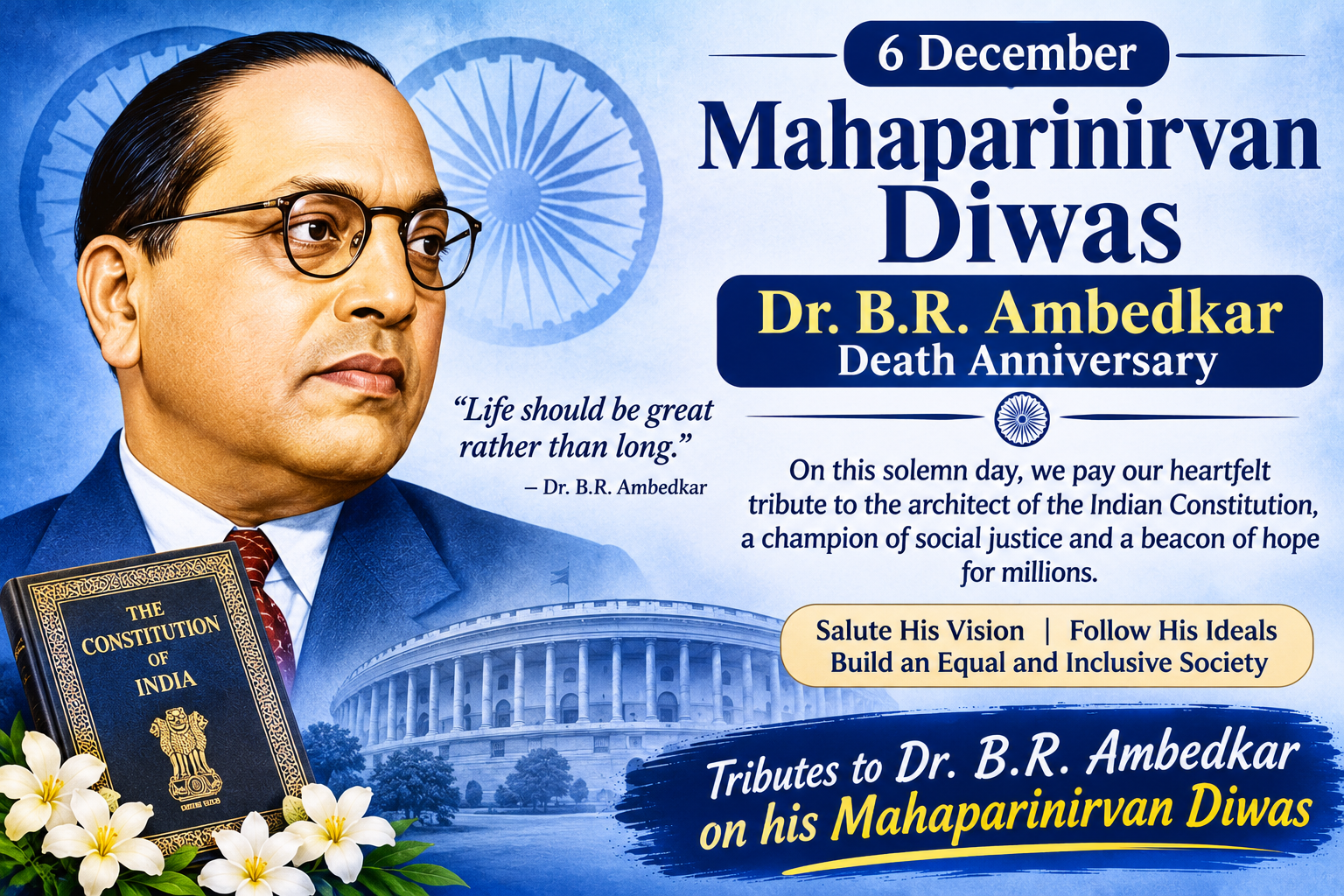
Mahaparinirvan Diwas is observed every year on 6 December to commemorate the death anniversary of Dr. Bhimrao Ramji Ambedkar, popularly known as Babasaheb Ambedkar. He was one of India’s greatest social reformers, a distinguished scholar, economist, jurist and the principal chairman of the Constitution’s Drafting Committee.
Dr. B.R. Ambedkar dedicated his life to fighting social discrimination, promoting equality and ensuring justice for every individual. His contributions to Indian society continue to inspire generations to stand for education, freedom, dignity and equal rights.
Who Was Dr. B.R. Ambedkar?
Dr. B.R. Ambedkar was born on 14 April 1891 in Mhow, Madhya Pradesh. Despite facing significant social discrimination and challenges during his early life, he pursued higher education and became one of the most influential intellectual and political leaders in Indian history.
He earned degrees from prestigious institutions, including Columbia University and the London School of Economics.
His dedication to education, social reform and constitutional values made him a powerful voice for equality and justice.
Why Is Mahaparinirvan Diwas Observed?
Mahaparinirvan Diwas marks the death anniversary of Dr. B.R. Ambedkar, who passed away on 6 December 1956.
The term ‘Mahaparinirvan’ is associated with the Buddhist concept of attaining final liberation from the cycle of birth and death.
On this day, people across India pay tribute to Babasaheb Ambedkar and remember his contributions towards building a society based on equality, liberty, fraternity and justice.
Thousands of followers visit Chaitya Bhoomi in Mumbai, where he was cremated, to pay their respects.
Major Contributions of Dr. B.R. Ambedkar
Dr. Ambedkar made remarkable contributions to India’s social, educational, political and economic development.
1. Architect of the Indian Constitution
Dr. B.R. Ambedkar served as Chairman of the Drafting Committee of the Indian Constitution. His leadership and legal knowledge helped shape a constitutional framework that protects fundamental rights and promotes equality and justice.
2. Champion of Social Equality
He strongly opposed caste discrimination and untouchability. He worked throughout his life to ensure dignity, equal rights and opportunities for disadvantaged communities.
3. Promotion of Education
Dr. Ambedkar believed that education was one of the most powerful tools for social transformation. His famous message, “Educate, Agitate, Organize,” continues to motivate people to pursue knowledge and fight injustice.
4. Advocate for Women’s Rights
He supported women’s empowerment and worked towards improving women’s rights in areas such as marriage, inheritance and social equality. His efforts as India’s first Law Minister included promoting reforms through the Hindu Code Bill.
5. Contribution to Economic Development
As an economist, Dr. Ambedkar contributed important ideas on India’s financial system, labour welfare, monetary policy and economic development.
Important Values and Teachings of Dr. Ambedkar
Dr. Ambedkar’s life and work teach us valuable lessons that remain relevant today.
- Equality: Every individual deserves equal rights, respect and opportunities.
- Education: Knowledge empowers people to improve their lives and society.
- Justice: A fair society must protect the rights and dignity of every person.
- Liberty: Individuals should have the freedom to think, learn and express themselves.
- Fraternity: Unity, mutual respect and brotherhood are essential for a strong nation.
- Self-Respect: Every person deserves dignity regardless of their social or economic background.
How Is Mahaparinirvan Diwas Observed?
Mahaparinirvan Diwas is observed with respect and remembrance across India.
Common activities include:
- Paying floral tributes to Dr. B.R. Ambedkar’s portraits and statues.
- Organising memorial programmes and public gatherings.
- Conducting educational seminars and discussions about his life.
- Reading and sharing his writings, speeches and teachings.
- Organising awareness programmes on equality and human rights.
- Encouraging students and young people to follow his message of education and social responsibility.
Relevance of Dr. Ambedkar’s Vision in Today’s Society
Even today, challenges such as social discrimination, unequal opportunities, educational gaps and economic inequality exist in different parts of society.
Dr. Ambedkar’s vision reminds us that true progress is possible only when everyone receives equal opportunities and lives with dignity.
His emphasis on education, constitutional values, social justice and individual rights continues to guide efforts towards building an inclusive and progressive India.
Young people can honour his legacy by gaining knowledge, respecting diversity, standing against discrimination and contributing positively to society.
Conclusion
Mahaparinirvan Diwas is not only a day of remembrance but also an opportunity to reflect on the values and principles taught by Dr. B.R. Ambedkar.
His lifelong struggle for equality, education, liberty and justice transformed Indian society and laid the foundation for a more inclusive nation.
Let us remember Babasaheb Ambedkar by following his ideals and working towards a society where every individual has equal rights, dignity and opportunities.
“Educate, Agitate, Organize.” – Dr. B.R. Ambedkar
May his vision continue to inspire generations to build a stronger, fairer and more equal India.
